When choosing a steel door, most people look only at colour and pattern; yet the door's type — that is, the leaf layout and the way it opens — defines the foundation of security, insulation and aesthetics alike. Fitting a pivot door into a narrow apartment entrance is just as wrong as mounting a single 90 cm leaf on a wide villa façade is inadequate. In this guide we cover steel doors in four main types: single leaf, double leaf, combined (side-glazed/fixed-panel) and pivot. Using concrete criteria, we explain where each one fits, what dimensions it works in, and how it affects security and cost.
The Core Concepts That Define the Type
To read the differences between types correctly, a few technical concepts are common to all models and establish a shared language for comparison.
- Sheet thickness: The leaf body generally uses 1.2-2 mm DKP or galvanised sheet; galvanising provides long service life against rusting in humid environments and on exterior façades.
- Number of locking points: Security is measured not by a single cylinder lock, but by multi-point locking (usually 5-9+ points) that clamps the leaf to the frame all the way around, together with the fixed pins on the hinge side.
- Resistance class (TS EN 1627 / RC): Resistance to forced entry is classified from RC1 to RC6. RC2-RC3 is reasonable for homes; RC4 and above is intended for commercial/high-security use.
- Insulation infill: The polyurethane foam injected into the leaf contributes to heat and sound performance; rock wool raises fire and acoustic performance.
- Fire resistance (EI): In a fire-resistant door, performance is expressed in minutes such as EI30/EI60/EI90; the figure is the time for which integrity and insulation are maintained.
Single-Leaf Steel Door
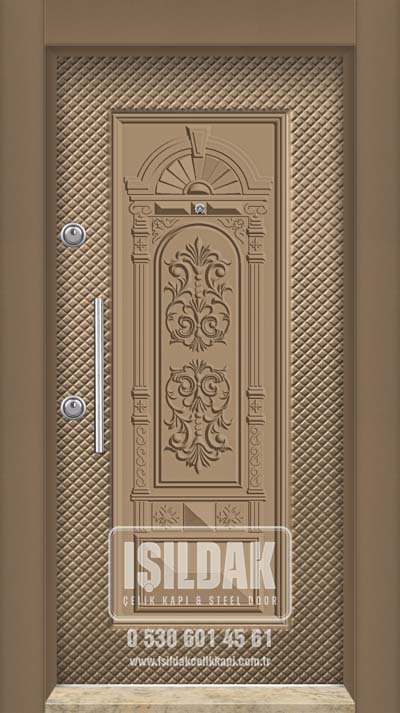
A single-leaf door consists of one moving leaf and is the standard type used in the vast majority of apartments. The rough opening is typically around 90x200 cm; the clear passage is mostly in the 80-90 cm range depending on the hardware. It is ideal for apartment flats, studios, 1+1/2+1 homes and interior office entrances. Because its manufacturing and installation are standardised, it is the most economical type; the other types are generally more expensive than the single leaf. It offers a wide aesthetic range, from flat, CNC-patterned, lacquered and laminox to wood-veneer finishes. In terms of security, since all the hardware is concentrated on a single closing line, reaching a high RC class is relatively easy; with multi-point locking, a steel frame and polyurethane infill, serious sound reduction is achieved between the flat and the stairwell.
Double-Leaf Steel Door
A double-leaf door consists of two leaves side by side. In most applications, one is the active leaf for daily use and the other is normally a fixed passive leaf; when moving furniture or large appliances, the second leaf opens too, providing a wide opening. The leaves can be equal in width (symmetrical) or of different widths (asymmetrical).
Where it is used and a note on security
It is suitable for villa and detached-house entrances, duplex flats, luxury homes with wide hallways, store and commercial entrances, and spaces wider than 120 cm; a very wide single leaf sags and places excessive load on the hinges. The critical point is the centre line where the two leaves meet: the passive leaf must be clamped to the frame with bolts (espagnolette) at the top and bottom, and the active leaf must be clamped to the passive leaf with a multi-point lock. When properly configured, a double-leaf door reaches the same security class as a single leaf. The cost, however, is markedly higher than a single leaf because of the two leaves, additional hinges, bolts and the wide frame.
Combined Door: Side-Glazed and Fixed-Panel
A combined door is created by adding a fixed section to the side of or above a leaf. This fixed section can be glass for light (side-glazed), a closed decorative panel, or a horizontal transom on top; in other words, the leaf can be single or double, and what makes it combined is that an integrated fixed panel has been added to its side. It is ideal for spaces where the entrance opening is wider than standard but does not require a full double leaf, for homes that want natural light in the hallway, and for office and clinic entrances.
The security of the glass
The most frequently asked topic is the security of the glass section. Here, not ordinary window glass but laminated (glass-film-glass) safety glass must be used; even if laminated glass breaks, it does not shatter — the fragments stay held in the film and prevent quick entry. Whether the side panel is glass or solid, it must be mounted to the frame with a steel profile in such a way that it cannot be removed from the outside. The cost is added on top of the single leaf according to the panel size and glass quality.
Pivot Door
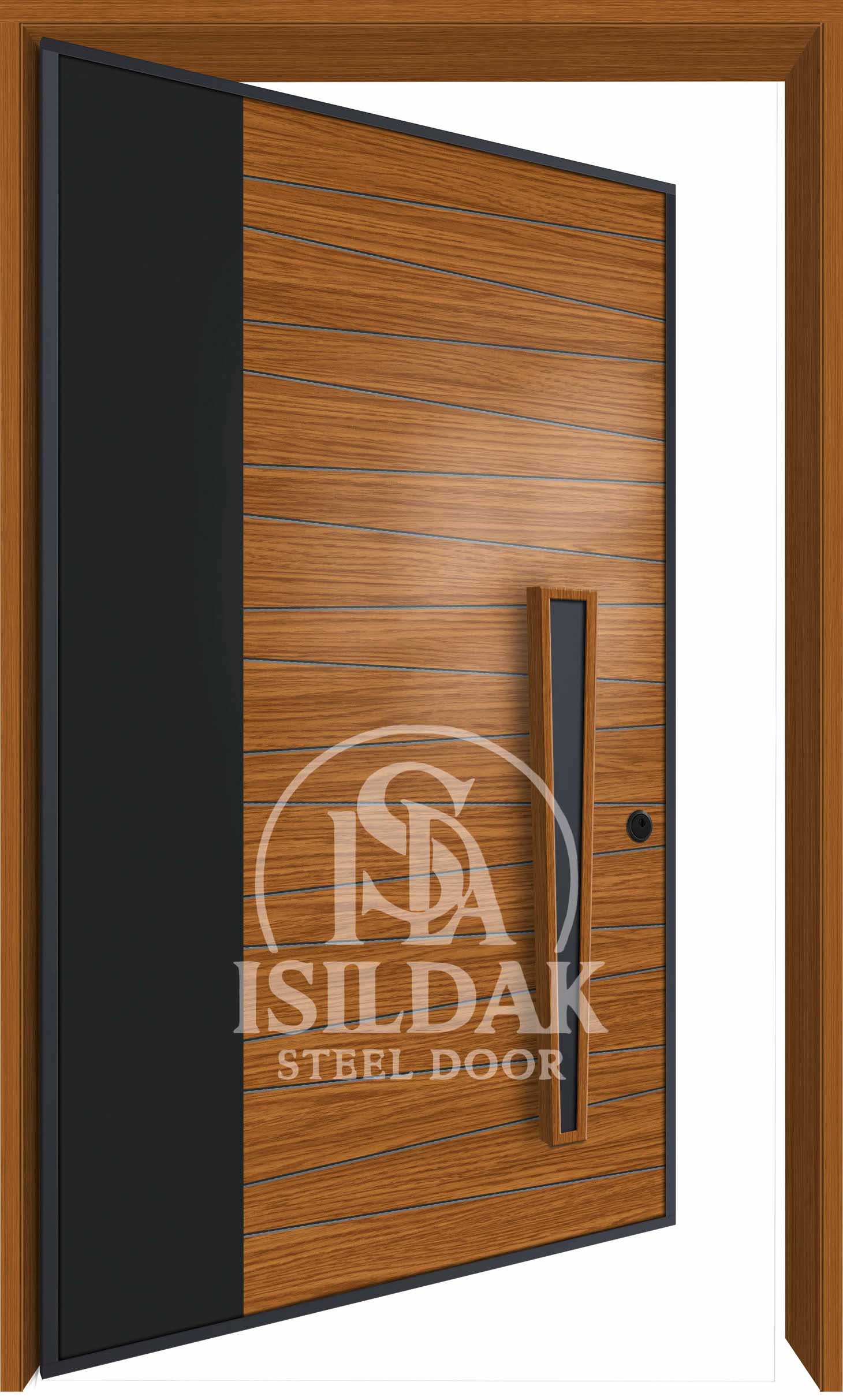
A pivot door turns around a vertical axis (pivot spindle) passing through the top and bottom of the leaf, rather than on side hinges. Because the weight is transferred not to the hinges but to a load-bearing mechanism set into the floor, the door can be much larger and heavier; the result is a wide, striking entrance that creates a strong architectural accent. Luxury villas, modern architectural projects, corporate building and plaza entrances, boutique hotels and prestige commercial entrances are its most fitting addresses. Even in a single leaf, widths of 110-130 cm and above are possible; this scale is not suitable for narrow apartment openings. A properly designed pivot door with multi-point locking can offer RC-class security despite its size; since the leaf rotates, the perimeter gasket detail and closing tolerance must be precisely adjusted. Because of its special mechanism and large leaf, it is generally the highest cost segment, and it requires a suitable floor and a wide façade.
Which Type for Which Space? Selection Criteria
The decision becomes clear with three questions: How wide is the entrance opening? What is the character of the space? Is the priority security, aesthetics or light? The scenarios below summarise common situations.
- Standard apartment flat (~90 cm): Single leaf; the most economical and practical, and more than sufficient in terms of security.
- Villa/duplex (130-180 cm, visual accent): Double leaf or side-glazed combined; wide passage for furniture and a symmetrical façade.
- Dark hallway, light desired: Side-glazed combined (with laminated glass); natural light without compromising security.
- Modern villa/corporate entrance, prestige priority: Pivot door; large scale with a suitable façade and budget.
- Store/commercial space (wide opening): Double leaf; flow eases when both leaves open.
No type is absolutely superior to another; the right one is the one that suits the dimensions and purpose of the space. Whatever the type, sheet thickness, the number of locking points, the RC class and the insulation infill must not be neglected. Aesthetics are the showcase; security is the door's unseen skeleton that does its real job. Moreover, the door's exact fit to the opening is critical: forcing a ready-made standard door into the wrong opening creates problems with the gasket, the closing tolerance and the lock alignment. That is why serious manufacturers first carry out an on-site survey and take measurements; especially in double-leaf, combined and pivot doors, millimetre-precise measurement is a precondition for security and insulation.
Işıldak Çelik Kapı, as a company that manufactures steel doors directly, produces doors to space-specific dimensions at its production facility in Sancaktepe; and it provides measurement, manufacturing and installation service across Istanbul and the European Side. From single leaf to pivot, across all types, it offers free survey and consultancy to determine the most suitable solution for your space; this way you can make the decision on type, dimensions and security not by guesswork but with real data taken on site.
Frequently Asked Questions
Is a double-leaf steel door less secure than a single leaf?
No. With the right hardware it reaches the same security class. The critical point is the centre line: the passive leaf must be clamped to the frame with bolts at the top and bottom, and the active leaf must be clamped to the passive leaf with a multi-point lock; when this configuration is done correctly, no weak point remains.
Does the glass in a side-glazed combined door pose a security risk?
Not if the correct type of glass is used. Not ordinary window glass but laminated (glass-film-glass) safety glass must be used; even if it breaks it does not shatter and it prevents quick entry. The side panel must be fixed to the frame with a steel profile in such a way that it cannot be removed from the outside.
Can a pivot door be fitted to any space?
No. A pivot door is large and heavy; it requires a wide façade and a suitable floor, because the weight is transferred to a load-bearing mechanism set into the floor. It is not suitable for narrow apartment openings, but it is ideal for modern villa, corporate building and prestige commercial entrances.