Two doors stand side by side: both grey, both labelled "steel door," identical from a distance. Yet one sells for three times the price of the other. That is because a steel door's value is hidden where the eye cannot see once it is closed: the thickness of the sheet, how many points the lock engages, the fill inside the leaf, how firmly the frame grips the wall. This guide aims to turn a steel door's price from a mere "tag" into a "technical report card"; once you understand why the price changes, you will also know what money buys what.
Sheet Thickness and Raw Steel
The single item that most determines the price is the thickness of the sheet. On the outer face of the leaf, sheets generally between 0.60 mm and 2 mm are used; these millimetres multiply both impact resistance and steel consumption, so a door with 1.5 mm sheet is markedly more expensive than one with 0.80 mm sheet. Because sheet steel is traded on global commodity exchanges, the exchange rate and raw-material prices feed directly into the cost; the difference between the price six months ago and today's is often not a "markup" but a raw-material reality.
Strength is not just about the outer sheet; you need to look at three layers:
- Outer leaf sheet: The visible surface; the first layer to resist impact and force.
- Inner skeleton profile: The backbone of the leaf; it provides the real resistance against bending.
- Frame sheet: The part that connects the door to the wall and carries the hinge load; it goes unnoticed, but half of the durability is here.
In cheap doors, even if the outer sheet looks impressive, the skeleton may be weak; this is why a "lightweight steel door" is often a warning sign.
The Locking System: The Heart of Security
A large part of the price difference relates to security after the door is closed. While economy doors have simple cylinders that lock at a single point, quality doors use multipoint locking mechanisms. When you turn the key, the door latches onto the frame at five to seven points along the top, bottom and side edges, so a burglar must defeat not a single point but all of them.
The second decisive element is the cylinder (barrel). Good doors favour cylinders that resist breaking, drilling and the impact-opening technique known as "bumping." The lock is the easiest but worst place to economise; even the door with the thickest sheet is insecure with a poor lock.
Surface Finish and Galvanisation
The finish is not merely aesthetic; it is a shield protecting the sheet against corrosion, affecting both appearance and lifespan. The common types are as follows:
- Laminate / membrane: Widespread in the economy segment; offers a wood-patterned look, with limited resistance to outdoor conditions.
- Lacquer (paint): A smooth, modern look from oven-baked paint; durable when well applied, but the workmanship is expensive.
- Steel / stainless and special panel: The top segment; the group most resistant to both impact and outdoor conditions, and the most expensive.
The truly critical question is whether the sheet beneath the finish is galvanised. Galvanising is the zinc coating that protects steel against rust; on ungalvanised sheet, rust over the years pushes the finish up from below and destroys the door.
Insulation, Custom Sizing and Certificates
Insulation Fill
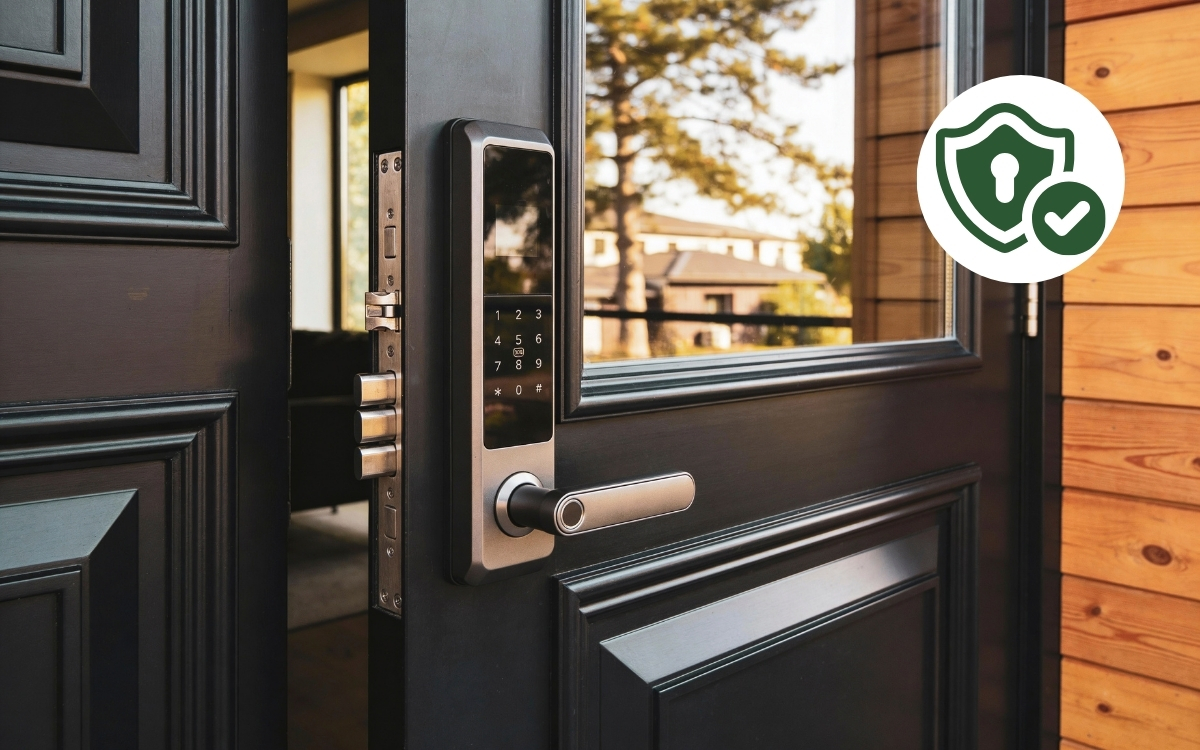
What the inside of the leaf is filled with determines the thermal and acoustic insulation. While hollow leaves offer poor insulation, polyurethane fill or rock wool both reduces heat loss and lowers sound transmission. Features such as a smart lock (fingerprint, PIN, card) also raise the price.
Custom-Sized Production
If your opening is non-standard, the door is produced to custom size. Wide, tall, double-leaf or arched productions cost more in both material and labour; this is not a defect but the result of bespoke manufacturing.
RC Certification and Fire Resistance
The strongest document proving a door's security is an independent test result. The TS EN 1627 standard classifies doors' burglary resistance from RC2 to RC6; the higher the number, the longer the door withstands forced-entry tests, and the common target in homes is the RC2-RC3 class. For fire doors, the EI value (for example EI30, EI60) indicates how many minutes the door resists fire. A certified door is more expensive than an uncertified one because the cost of laboratory testing is borne; but that label is the only concrete proof backing the door's claim.
Installation, Warranty and the Sales Chain
However high its quality, a steel door is weakened when it is not installed correctly; how many points the frame is bonded to the wall with steel anchors directly affects its resistance to force. That is why the first question when comparing prices is this: does this price include installation? Some sellers quote a low tag, then add installation, transport and removal of the old door afterwards. The warranty is also part of the price; "there is a warranty" is not enough, what it covers is what matters.
Part of the price difference comes not from the material but from the sales chain. A door passes through many hands such as factory, wholesaler, dealer and store; each link adds its own profit and the price swells. Buying directly from the manufacturer removes these intermediate layers and can offer a door of the same technical specification more affordably.
Conclusion: The Hidden Cost of a Cheap Price
The same "steel door" can differ by a factor of two or three, because this is a category name, not a quality level. Under the same label you will find a door with 0.60 mm sheet, a single-point lock and no certificate, as well as one with 1.5 mm galvanised sheet, a multipoint lock, fill and an RC certificate. The cost of a cheap door is not paid up front but in instalments: rusting paint, a lock that loses its adjustment, a cold leaf. The right question should not be "which is the cheapest" but "what is a fair price for my needs."
Işıldak Çelik Kapı stands in this chain without intermediaries: as a manufacturer producing in its own facility in Sancaktepe, it explains every technical item transparently. Serving Istanbul and the European Side, the company comes to your address on request with a free site survey and measurement, and its expert team determines the level that suits your needs on the spot.
Frequently Asked Questions
Why can the cheapest steel door be risky?
Because cost-cutting is done where the eye cannot see: thin and ungalvanised sheet, a single-point lock, an unfilled leaf, uncertified production and a price that excludes installation. The hidden cost returns over the years as rust, heat loss and a security weakness.
Is an RC certificate essential, and what does it do?
An RC certificate (TS EN 1627) shows that the door has been tested and certified against forced-entry burglary in an independent laboratory; RC2-RC3 is the common target for homes. Although not mandatory, it is the only concrete document proving a security claim.
Why is the same door more affordable from the manufacturer?
Because in a direct purchase from the manufacturer, the profit layers of intermediate links such as the wholesaler and dealer fall away. A door with the same sheet, lock and fill can be offered more affordably because the sales chain is shorter.