The flat door is your home's first line of defence and the first face that greets your guests. A poorly chosen door means years of regret: sound seeps in from the hallway, the lock binds, the finish fades. A well-chosen door, on the other hand, does its job quietly, securely, and elegantly for 15-20 years. Below, we examine the points you should check before ordering, using technical criteria.
Correct Sizing and Opening Direction
In any steel-door project, the most expensive mistake is the wrong measurement, because the door is manufactured to fit the frame and correcting it afterwards is nearly impossible. The measurement is taken from the wall opening including the frame (the rough frame dimension); it should never be given by looking at the old leaf alone. A good surveyor measures the width at three points and takes the smallest value as the basis.
The opening direction is at least as critical as the measurement; it determines which side the hinge is on and whether the door opens inwards or outwards. In apartment flats, the standard is for the leaf to open inwards; this is both correct for evacuation and does not narrow the hallway.
- Leaf width: Ideally the clear passage should be at least 80-90 cm so that furniture can be moved through; in narrow openings, a fixed side leaf solution can be considered.
- Frame depth: It must be chosen to suit the wall thickness; an overly deep frame in a thin wall, or an insufficient frame in a thick wall, will create problems.
- Landing compatibility: An outward-opening door must not strike the opposite door or the railing and must not block evacuation; many building managements also require uniformity of exterior colour and model.
Sound Insulation Against Neighbour Noise
The most common complaint in apartment living is the noise coming from the hallway, the lift, and the neighbours. A good steel door cuts these sounds considerably; this depends on its internal structure. Insulation is measured by the decibel (dB) reduction value: while ordinary interior doors stay around 20-25 dB, a steel door with proper filling and seals can in practice provide 30-40 dB of insulation. Three factors determine this:
- Internal filling: Polyurethane (PU) foam filling is markedly superior to honeycomb cardboard for sound and heat insulation; it adds weight to the leaf and breaks the sound bridges.
- Double-row seals: The rubber seals running around the frame close off the gaps through which sound passes when the leaf shuts; a double row improves insulation over a single row.
- Bottom sweep: The space under the door is the biggest sound leak; an automatic drop-down bottom seal (guillotine) or a fixed threshold cuts this off.
Lock Security and Cylinder Armour
However robust the door's steel may be, security is only as strong as the weakest link in the chain; that link is most often the lock and the cylinder. In a quality system, while the body lock drives horizontal bolts, pins also engage on the hinge side and in the upper and lower directions; in this way the leaf is locked at multiple points around its perimeter.
Cylinder (Barrel) and Protection Against Breaking
A common burglary method is to break the cylinder, known as the barrel, with pliers (lock snapping) and turn it. For this reason, on a good door the cylinder is protected by a steel cylinder armour (escutcheon) that prevents tools from getting in. The cylinder should be a model that is protected against key copying (with a security card) and has drill-resistant pins; it being easily replaceable is also important.
The European standard TS EN 1627 classifies the burglar resistance of doors from RC1 to RC6. For residences, RC2 and RC3 are practically meaningful: RC2 resists opportunistic forcing with simple tools; RC3 resists more serious tools such as a screwdriver, crowbar, and wedge for a certain period. Falling into this class depends not only on thick sheet metal but on the lock, hinge, and cylinder armour being tested as a whole.
Sheet Thickness and Fire Resistance
The strength of the leaf depends largely on the steel sheet thickness. The body sheet generally varies between 0.8 mm and 1.5 mm. Even so, looking at a single figure is misleading: what matters is the box structure formed by the inner and outer sheets, the reinforcing profiles, and the integrity of the filling. Galvanised sheet delays rusting.
Fire Resistance (EI Value)
Fire-resistant doors are rated by the EI class: E denotes integrity (flame and smoke not passing through), I denotes insulation (the rear face not overheating); the number written beside it is the duration of the resistance in minutes. For example, an EI 30 door does not let flame and heat through to the other side for 30 minutes, while an EI 60 door does so for 60 minutes; this buys critical time for evacuation. It is not enough for the label to say EI; ask for an accredited test report.
Finish, Installation, and Warranty
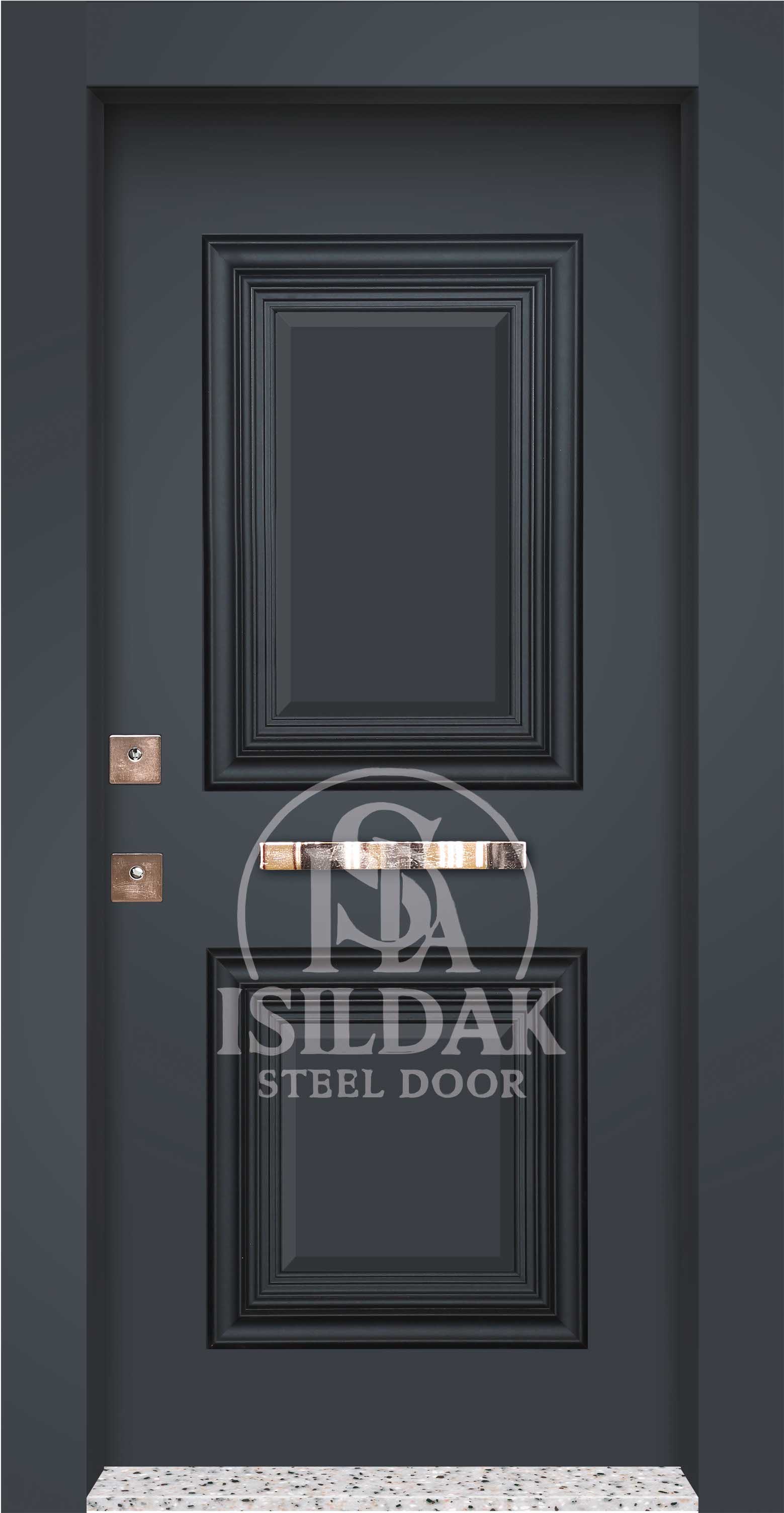
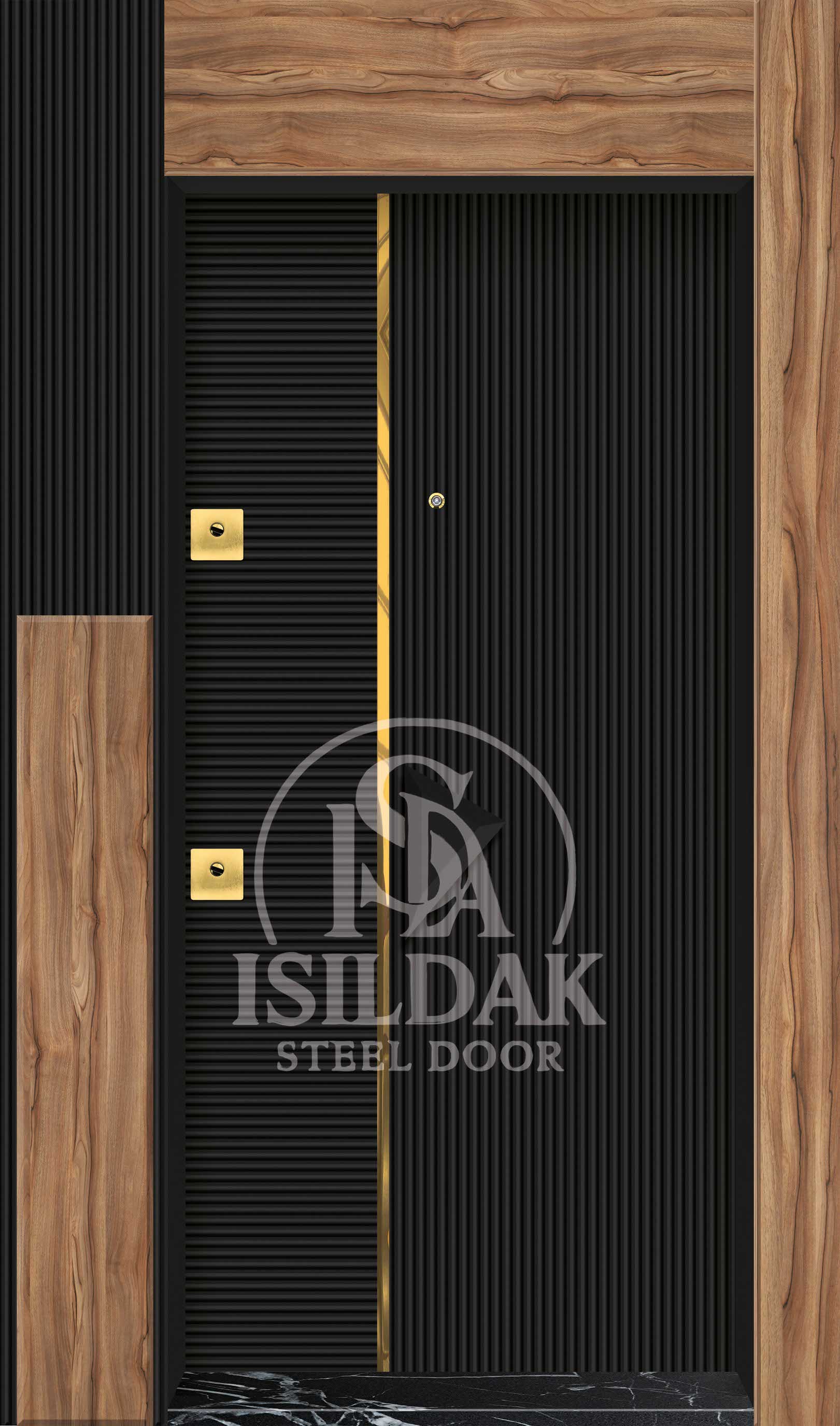
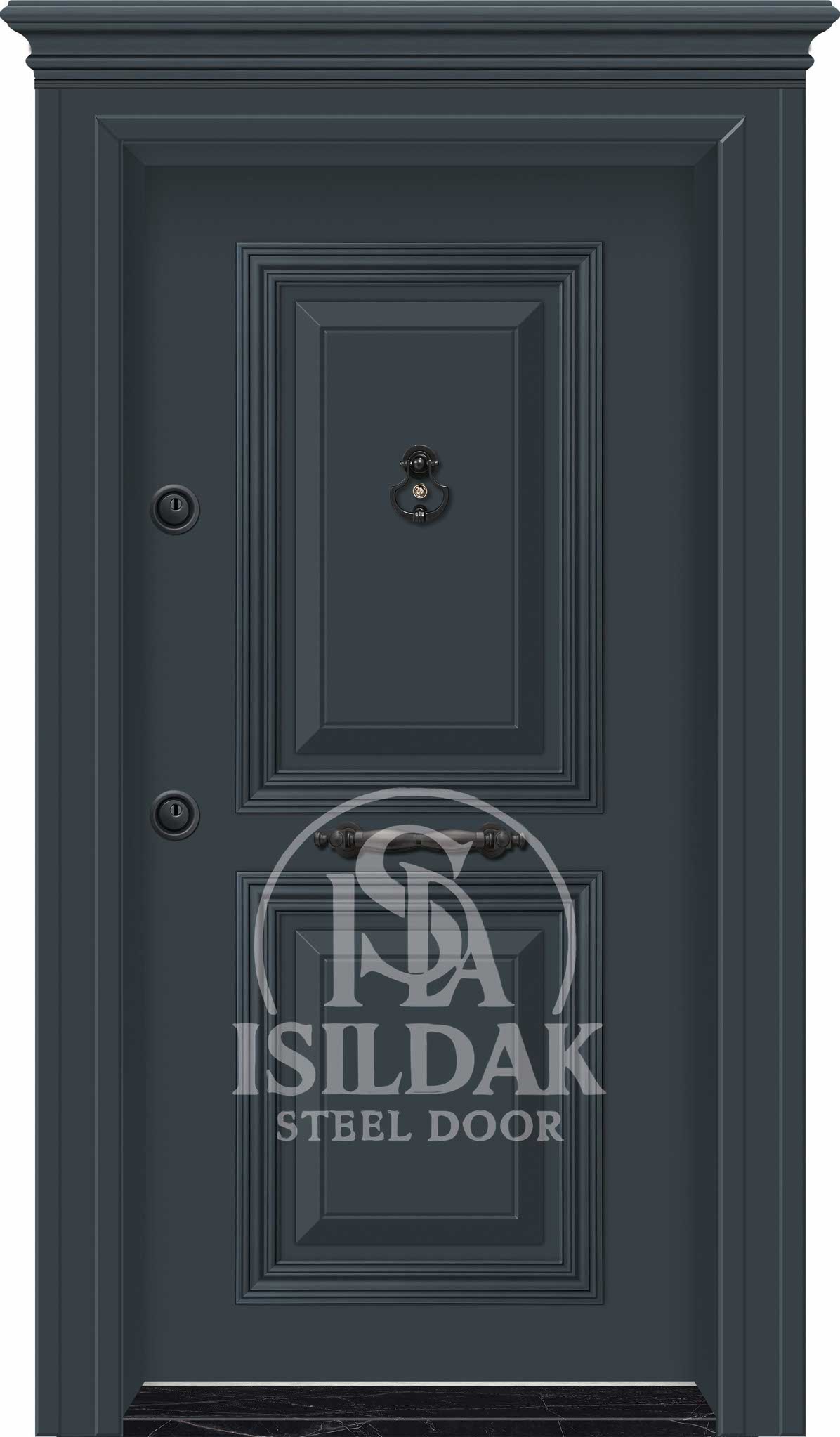
As important as the door's appearance is how that appearance will hold up years later. Lacquer (oven paint) offers flat colours and is UV-resistant but can be scratched by a hard impact. Laminate/PVC gives a wood pattern and is scratch-resistant; on sun-facing facades a UV-resistant series should be chosen. Membrane resists moisture. Dark tones hide fading and fingerprints.
Even the highest-quality door is devalued by poor installation. In correct installation, the frame is anchored to the wall at multiple points with steel anchors/dowels; otherwise, however strong the lock may be, the frame can be levered out of place with a crowbar. A written document is essential for the warranty: a good manufacturer provides a structural warranty for the leaf and frame, and a separate guarantee for the mechanical components and the finish; confirm that workmanship is included in the coverage. Although the delivery time is a few working days for a standard size, it may be extended for custom sizes, custom colours, or fire-certified models.
Finally, knowing the difference between a manufacturer and an intermediary seller adds value. Işıldak Çelik Kapı is a manufacturer that produces its doors in-house at its facility in Sancaktepe, Istanbul; it delivers across Istanbul and the European Side, carries out a free site survey at your address for sizing and opening direction, and helps you settle the finish and colour choice with expert guidance. Working directly with the manufacturer lets you get clear information without a broker stepping in.
Frequently Asked Questions
Which RC class is sufficient for an apartment door?
For residences, RC2 and RC3 are practically meaningful: RC2 resists opportunistic forcing, while RC3 resists more serious tools such as a crowbar and screwdriver for a certain period. For the class to be valid, the lock, cylinder armour, hinge, and frame must be tested as a whole.
What is the most important factor for sound insulation?
It is not a single factor but several working together that is decisive: dense polyurethane filling, a double row of seals around the frame, and the automatic sweep under the door. These three together cut hallway sounds considerably.
Can I take the measurement myself and place the order?
It is not recommended. Door openings are usually off by a few millimetres, and a wrong measurement is an uncorrectable mistake. The safest route is for an experienced surveyor to take the measurement on site and assess the opening direction and wall thickness; most manufacturers do this survey free of charge.