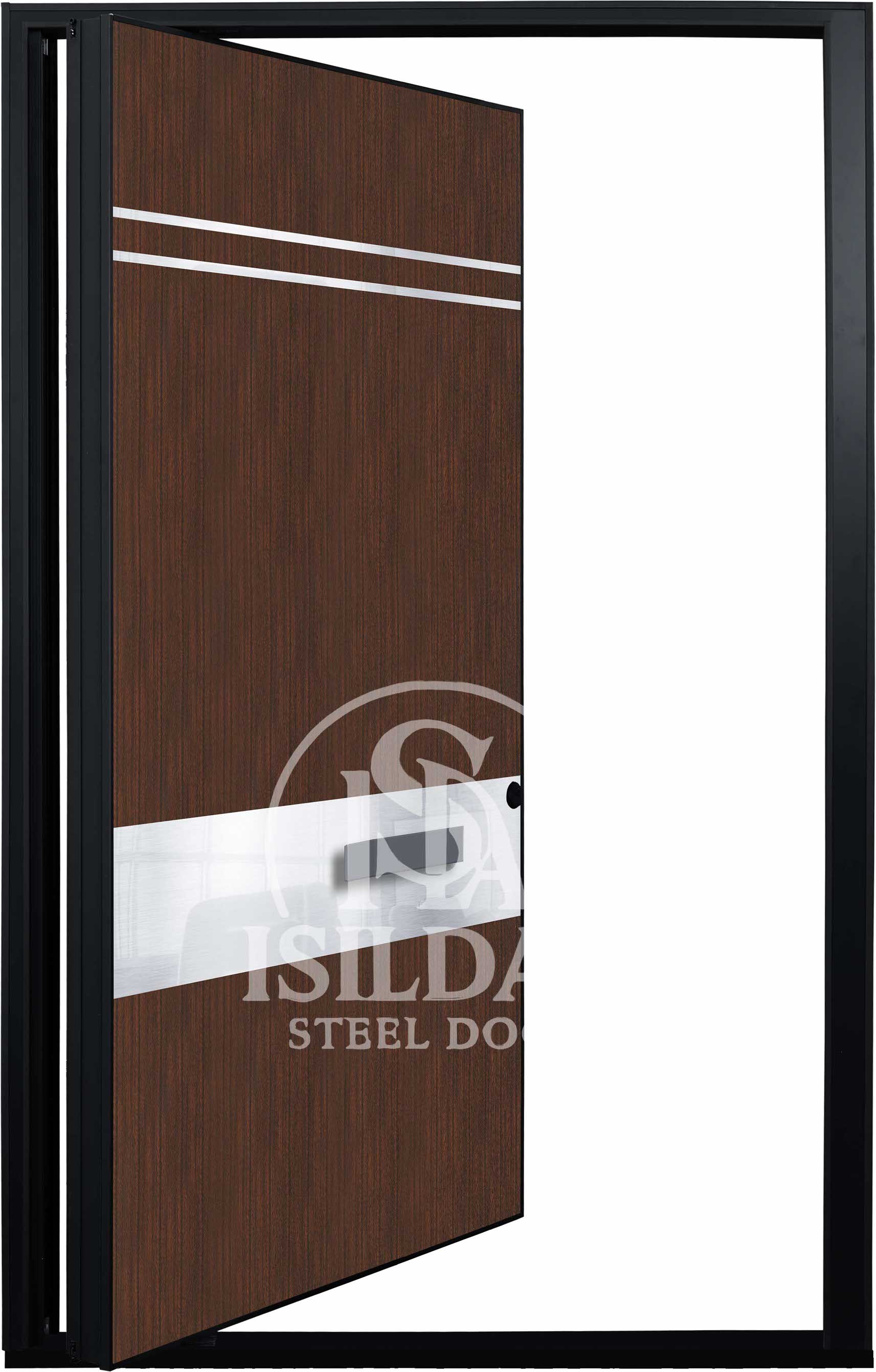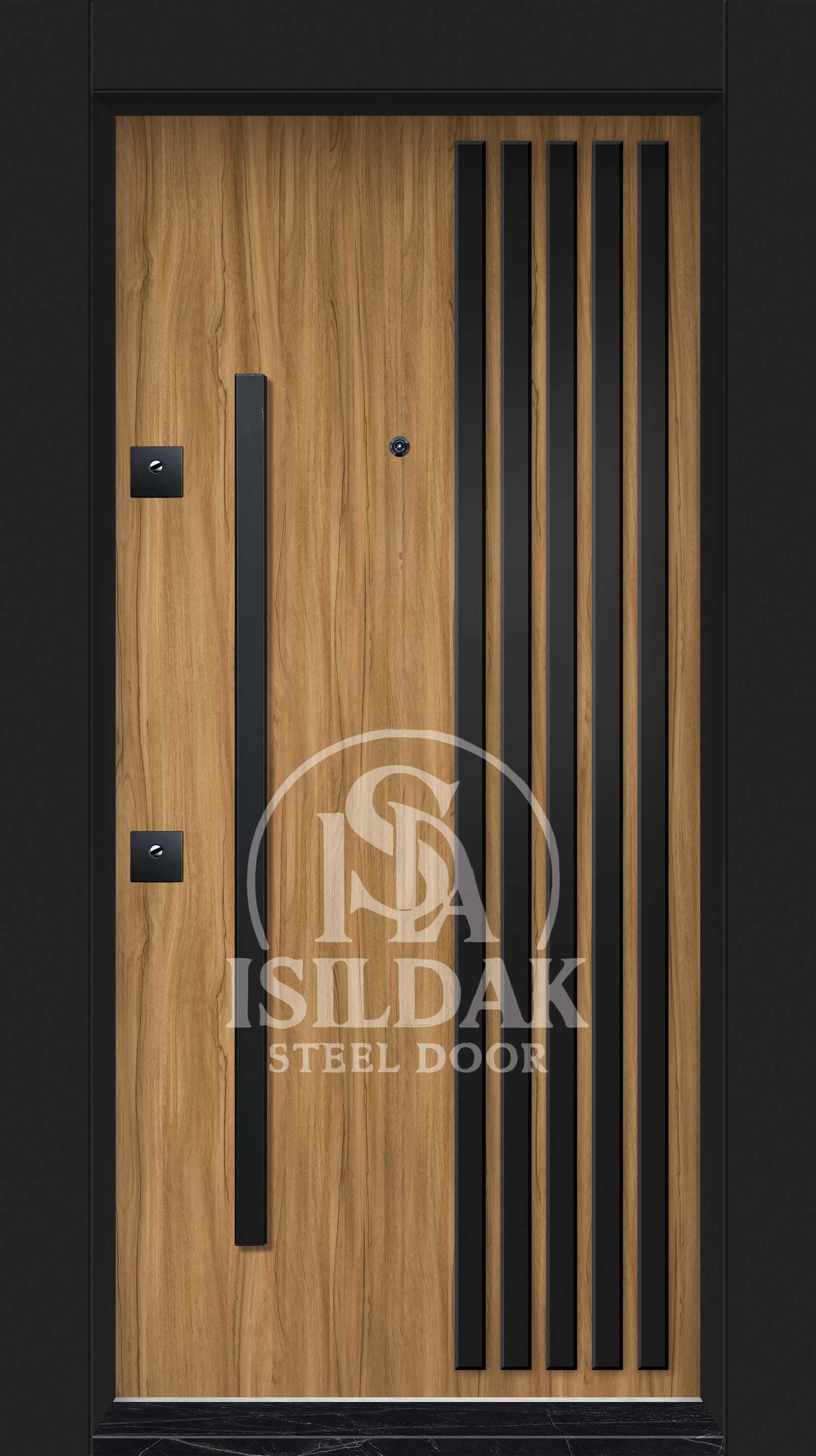
Most of the time we want two things from a door, yet for years these two were thought to be at odds: the natural wood texture that warms us as we step inside, and the sturdiness that refuses to yield to force or the weather. Solid wood is warm; but it swells when it absorbs moisture, cracks when it dries out, warps as the seasons change, and cannot offer the reassurance steel provides against a crowbar. A pure steel door, on the other hand, is strong but in its traditional form feels cold. Wood-look steel doors resolve exactly this dilemma: steel in the body and security, wood in the look and feel. In this guide we examine how these two worlds come together.
The Limits of Wood and the Answer of Steel
Wood is a hygroscopic material; it absorbs and releases the moisture in the air. This cycle undermines dimensional stability: in summer it swells and rubs against the frame, in winter it shrinks and leaves gaps along the hinge line. On the security side, solid wood cannot provide the structural resistance of steel against being levered up; its weakest point is the lock housing.
In a steel-bodied door the skeleton is usually a closed box profile bent from galvanized or DKP sheet plates 1.2 mm to 2 mm thick. Rockwool or polyurethane filling is placed inside; this provides both thermal and acoustic insulation. As a result, while the appearance of wood is preserved on the outside, what remains inside is a frame that is unaffected by moisture, does not warp, and locks at multiple points.
- Dimensional stability: The steel body does not swell or shrink with moisture; the door closes with the same precision for years.
- Fire resistance: In fire-door models, fillings that hold back the flame for a defined period, measured by the EI class, can be used.
- Mechanical security: A multi-point lock and a reinforced lock housing offer resistance that is impossible with solid wood.
- Acoustic insulation: The solid box body and double gasket line markedly reduce outside noise.
Security: Which Standards to Look At
The phrase "steel door" alone is no guarantee of quality; what matters is measurable performance. A door's resistance to force is expressed under TS EN 1627 with RC (Resistance Class) classes. RC2 targets a defined period of resistance against an opportunistic burglar working with simple hand tools; RC3 aims for longer resistance against more serious tools such as crowbars. For homes, RC2 and above is a reasonable target. The backbone of security has three parts: multi-point locking fastens the leaf to the frame at several points, neutralizing any attempt to lever it up; the steel plate and hinge pins in the lock area prevent the leaf from being removed even if the hinges are dismantled; and cylinder protection calls for a core that, in line with the logic of EN 1303, resists breaking and drilling. Having a wood look requires no compromise on this performance; the veneer is on the surface, the skeleton stays the same.
The Coatings That Give Steel a Wood Texture
There are three ways to give a steel body a wood look; the difference between them determines the appearance, the price and the maintenance behavior. None of them is "fake"; each serves a different need.
Laminox (Laminated Wood Panel)
This is a hardened, impact-resistant coating obtained by pressing a decorative layer printed with a wood texture onto a carrier panel. It offers a rich range of patterns and resists scratching. Its advantage is its long life and pattern consistency; its limitation is that on open façades under constant rain and UV it requires suitable substructure.
PVC Membrane (Vacuum-Pressed Foil)
This is the bonding of a thick, wood-textured foil onto an MDF or panel surface under vacuum, with heat and pressure. Because it can wrap three-dimensional surfaces (panelled, cassetted, carved) in a single, seamless piece, it is very successful in classic designs. For exterior façades it is critical to choose UV-resistant (exterior-grade) foil; interior foil can fade in the sun.
Genuine Wood (Natural Veneer)
At the top segment, genuine wood veneer is applied to the steel body; the grain of species such as oak, walnut and iroko is felt exactly. In return it requires periodic maintenance: on the exterior façade the protective varnish or oil must be renewed. Thanks to the steel skeleton there are no warping or security problems; it is preferred in villas and restorations.
- Laminox: Hard, scratch-resistant, maintenance-free; modern and long-lasting.
- PVC membrane: Seamless on carved surfaces; economical; UV-grade foil is a must outdoors.
- Genuine wood: The most natural feel and value; requires periodic varnish/oil maintenance.
Which One for Which Project
The right choice depends on where the door stands and whether the façade gets sun. In villas, on wide, outward-facing leaves a strong security class and resistance to the weather are the priority; UV-resistant membrane or genuine wood, with the right eave detail, gives an effective result. At the entrances of boutique hotels, cafés and shops, the first impression takes precedence; the variety of patterns in laminox and membrane is an advantage for keeping the surface clean despite frequent contact. In historic-fabric and restoration projects, a steel door with genuine wood veneer looks period-appropriate from the outside while housing a contemporary frame behind it. The common point is this: the visible surface changes, the steel backbone keeps its standard.
UV Resistance, Corrosion and Maintenance
An exterior door has two enemies: sun (UV) and moisture/corrosion. Whatever the coating, it is essential that the steel underneath does not rust; for this reason, in quality manufacturing the body is made with galvanized (zinc-coated) sheet, or after a phosphate pretreatment it is electrostatically powder-coated and oven-cured. The color stability of the surface layer, meanwhile, depends on the UV class of the coating. Architectural measures such as eaves or canopies extend the life of every coating by reducing exposure to sun and rain. On the maintenance side, these doors are far easier than solid wood.
- Surface: Wipe with a cloth and mild detergent rather than abrasive chemicals; do not force the edges of the foil.
- Gasket: Check the rubber gaskets once a year; replace any crushed gasket.
- Lock and hinge: Maintain the cylinder with graphite or a Teflon-based product; apply suitable lubrication to the hinges.
- Threshold: Prevent water from pooling at the bottom threshold; moisture from below wears down even the sturdiest door.
Frequently Asked Questions
Does a wood-look steel door look as elegant as solid wood?
Depending on the coating technique it comes very close, and with genuine wood veneer the result is indistinguishable. Quality PVC membrane and laminox are also convincing to the eye and the touch, and what is more, they offer a more stable appearance. The difference is felt up close, when you touch it.
Do these doors fade in the sun on the exterior façade?
If the right coating class is chosen, no. A UV-stabilized membrane made for outdoor use, or a suitable varnish, keeps its color for many years. The problem usually arises from using an interior coating on an exterior door; eaves and canopies extend the life even further.
Which makes more sense, genuine wood or membrane/laminox?
It depends on the need. Genuine wood is for those who want the most natural feel and a premium perception and have time for maintenance; PVC membrane or laminox is ideal for those seeking a maintenance-free, durable and more economical solution, or a carved pattern.
Işıldak Çelik Kapı manufactures steel doors as a producer at its facility in İstanbul/Sancaktepe; including Bahçelievler, we deliver and install the laminox, PVC membrane and genuine wood veneer options across İstanbul and the European Side. To clarify which coating suits you according to your façade's orientation, climate and architectural language, we offer free survey, on-site measurement and expert consultancy.